
Does every wisdom tooth need to be extracted?
No. It is one of dentistry's most persistent myths: many people live their whole lives with their wisdom teeth without any problem. When a wisdom tooth erupts fully, sits well aligned with the other teeth and can be brushed like any other, there is no reason to remove it — it just needs to be kept an eye on at routine check-ups.
Extraction is only recommended when there is a concrete problem or a real, identifiable risk. The criteria we use in consultation are:
- An impacted or partly erupted tooth with disease or a specific risk identified at assessment, rather than automatic removal simply because it has not erupted.
- Recurrent pericoronitis — repeated inflammation and infection of the gum flap covering the tooth.
- Decay in the wisdom tooth or its neighbour — its position at the back of the mouth makes cleaning difficult, and a badly positioned wisdom tooth can cause cavities in the second molar.
- Cysts or associated lesions — visible on the X-ray, even without symptoms.
- Orthodontic reasons — when the orthodontist needs space or the wisdom tooth compromises the result of treatment.
What are the warning signs that a wisdom tooth is causing trouble?
Wisdom teeth usually come through between the ages of 17 and 25, and they don't always give advance warning. These are the most common signs that something is wrong:
- Pain at the back of the mouth, behind the last molars, that comes and goes in episodes.
- A swollen, red or painful gum over the erupting tooth.
- A persistent bad taste or bad breath — a sign that food and bacteria are building up under the gum.
- Difficulty or stiffness when opening your mouth, sometimes with pain radiating to the ear or jaw.
- Food that gets trapped in the same spot again and again, no matter how well you brush.
- Swelling in the face or tender lymph nodes on the same side.
What is an impacted wisdom tooth?
An impacted wisdom tooth is one that doesn't have the space or position to erupt fully. It may stay completely buried in the bone, remain partly covered by the gum, or grow at an angle — sometimes horizontally, pushing against the second molar.
The problem with partially erupted wisdom teeth is the opening in the gum: it creates a pocket where food debris and bacteria collect, out of reach of the toothbrush. That is what causes pericoronitis — the painful inflammation of the gum flap covering the tooth — and it tends to keep coming back as long as the tooth is there.
An impacted wisdom tooth can sit quietly for years without symptoms. That is why an X-ray assessment matters even when nothing hurts: it identifies badly positioned teeth, hidden decay or cysts before they damage the neighbouring tooth or the bone.
How does the assessment work? Do I need an X-ray?
Yes. The decision to extract — or not to extract — should never be made on pain alone. The assessment has two steps:
First, the clinical examination: the dentist looks at the position of the tooth, the condition of the gum, signs of inflammation or decay, and its relationship with the neighbouring teeth.
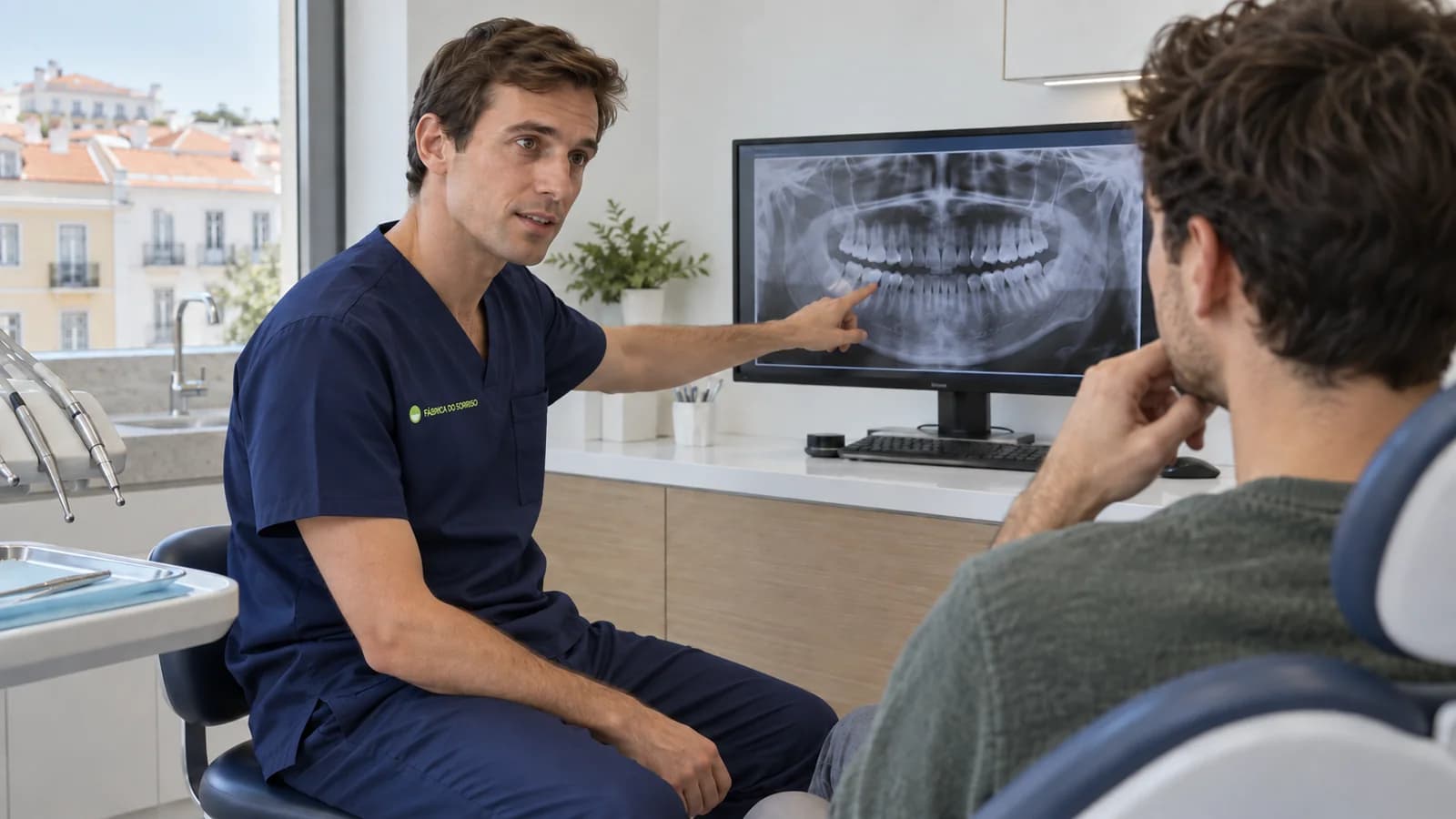
Then the panoramic X-ray (orthopantomogram), which shows all four wisdom teeth at once: the position and angle of each one, the depth of the roots, and how close they sit to important structures such as the nerve that supplies the lower lip. In more complex cases, a 3D scan (CBCT) may be requested to plan the surgery with millimetre precision.
With this information, the dentist can tell you clearly whether the tooth should come out, whether it can stay under observation, and how complex the extraction would be — which also determines the cost, presented to you before any treatment.
What is wisdom tooth extraction like, step by step?
Wisdom tooth extraction is one of the most common procedures in oral surgery and is done on an outpatient basis — you walk in and out of the clinic on the same day. The typical steps are:
- Local anaesthesia: the team checks its effect before starting. You may feel pressure or movement; report pain. If you feel anxious, discuss available support before the procedure day.
- Simple extraction — if the tooth has erupted and is accessible, it is loosened and removed with dedicated instruments, in around 20 to 30 minutes.
- Surgical extraction — if the tooth is impacted, a small opening is made in the gum and, if necessary, the tooth is divided into sections so it can be removed with minimal trauma. This usually takes 45 to 90 minutes.
- Stitches — in most surgical cases the gum is closed with sutures, often dissolvable.
- Post-operative instructions — you leave the clinic with written guidance on medication, food and care, and a direct contact for the team in case of any doubt.
What is recovery like? What should you eat and avoid?
Typical recovery takes 3 to 7 days. Swelling peaks on days 2 and 3 and then gradually subsides — this is normal and expected. For the first 48 hours, rest with your head elevated, apply ice to the outside of your face in 20-minute intervals and take your medication as prescribed.
For food, choose cold, soft options that need no chewing: yoghurt, ice cream, mashed potato, lukewarm or cold soup, smoothies (with a spoon, never a straw). From the third or fourth day, gradually reintroduce solid foods as comfort allows.
There are three golden rules: no smoking for at least 72 hours, no straws, and no vigorous rinsing in the first 24 hours. All three can dislodge the blood clot protecting the wound and cause alveolitis (dry socket) — a painful complication in which the bone is left exposed.
One important warning sign: if the pain gets worse instead of better on day 2 or 3 after the extraction, it may be dry socket. Don't wait it out — call the clinic. The treatment is simple and relieves the pain quickly.
When is it urgent to seek help?
Whether you are waiting for your assessment appointment or recovering from an extraction, certain signs mean the situation should be seen the same day:
- Fever together with the pain or swelling.
- Swelling that keeps growing and spreads to the face, neck or under the jaw.
- Difficulty swallowing, breathing or opening your mouth.
- Bleeding that does not stop with pressure from a gauze pad.
- Severe pain that does not respond to the recommended painkillers.
Contact the clinic for urgent advice. Difficulty breathing, speaking or swallowing, or heavy bleeding that will not stop, needs immediate medical help: call 112.
Find dental emergency contactsThe most common questions
- Does wisdom tooth extraction hurt?
- Local anaesthesia controls pain during the procedure. You may feel pressure; tell the team if you feel pain. Afterwards, discomfort and swelling depend on the extraction’s complexity. You receive aftercare and medication instructions suited to your needs.
- Should I have all four wisdom teeth out at once, or one at a time?
- It depends on the case. Removing all four in a single session has advantages — one recovery, one round of anaesthesia and a lower total cost — but it isn't always justified, especially if some wisdom teeth are healthy and well positioned. Many patients prefer to split it into two sessions, by side or by arch. The decision is made with you, based on the X-ray and the complexity of each tooth.
- How many days will I need off work?
- For a simple extraction, most people are back at work 1 to 2 days later. For surgical removal of impacted wisdom teeth, allow 2 to 4 days, and avoid intense physical effort for a week. If you have sedation, you cannot drive for the following 24 hours. We can provide a certificate to justify your absence if you need one.
- Do wisdom teeth make the other teeth crooked?
- It's a widespread belief, but the scientific evidence is weak: studies do not confirm that wisdom teeth are the main cause of crowding of the front teeth, which tends to happen with age even in people who have no wisdom teeth. So we do not recommend removing healthy wisdom teeth just "to stop the teeth going crooked". Extraction for orthodontic reasons is only justified in specific cases, assessed together with the orthodontist.
- How much does wisdom tooth extraction cost in Portugal?
- The extraction fee depends on tooth position, complexity and required tests. The published private panoramic X-ray fee is €35, separate from the first dental consultation. Confirm consultation, tests and surgery in the written quote before proceeding; check insurance or agreement terms with reception.
- I'm pregnant — can I have a wisdom tooth extracted?
- If the extraction is not urgent, the usual approach is to postpone it until after the birth. But an active infection should not be left untreated during pregnancy: pericoronitis and abscesses can and should be treated, with the appropriate precautions and medication, ideally in the second trimester. Always let the team know you are pregnant so we can adapt the plan.

Author: Dr. Carlos Sousa
Last updated October 7, 2026. This article is for information only and does not replace an appointment.