
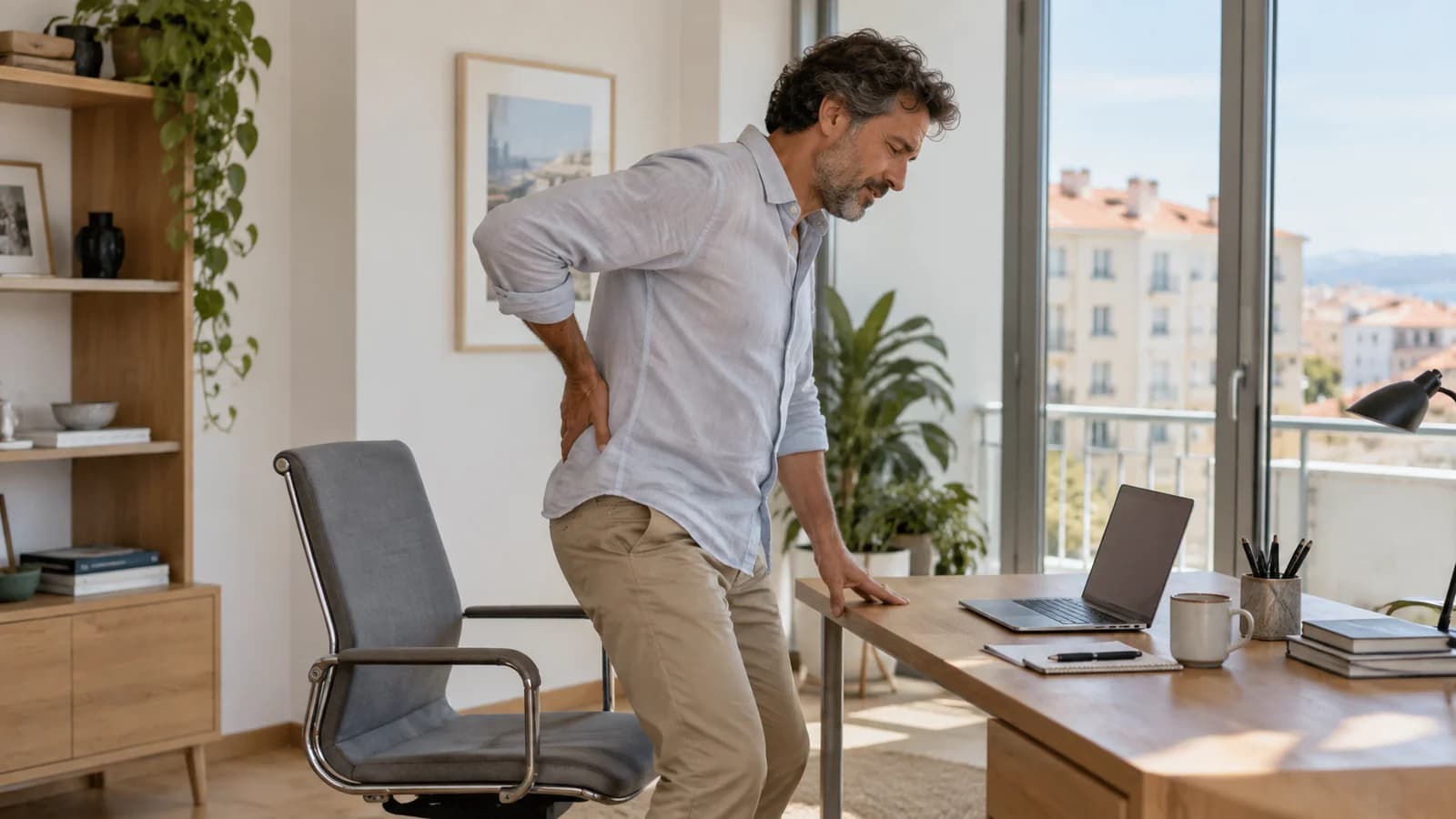
What is low back pain?
Low back pain — lumbago, or "lombalgia" in Portuguese — is the clinical term for pain located in the lumbar region: the lower part of the back, between the last ribs and the buttocks. It can appear suddenly (the classic "tweak" while lifting something) or build up gradually, and it can radiate into the buttock or leg, in which case it is called sciatica.
It is extraordinarily common: the World Health Organization identifies low back pain as the leading cause of disability worldwide, and most of us will feel it at least once. In the overwhelming majority of cases the cause is benign and mechanical — muscles, ligaments, spinal joints or discs — not a serious spine problem.
What are the most common causes of low back pain?
In more than 90% of cases, low back pain is "non-specific": there is no identifiable serious injury, but rather a combination of mechanical and lifestyle factors. The most frequent:
Strain or a sudden "tweak"
lifting with a bent trunk, abrupt twisting movements.
Sedentary habits and desk work
hours of sitting weaken the deep muscles that stabilise the spine.
Sustained posture
long drives, standing work in the same position.
Stress and muscle tension
chronic stress raises muscle tone and amplifies pain perception.
Excess weight and lack of physical activity
more load on the spine, less muscular support.
Degenerative changes
natural wear of discs and joints with age (not always painful: many disc herniations seen on scans cause no symptoms at all).
Pregnancy
the shifting centre of gravity and hormonal adaptations overload the lumbar region.
Acute or chronic low back pain: what is the difference?
Acute low back pain lasts less than 6 weeks and is, in most cases, self-limiting — it improves with adapted movement, simple pain relief when needed and a progressive return to activity. Subacute low back pain extends from 6 to 12 weeks.
Low back pain is called chronic when it persists beyond 12 weeks. Here the picture changes: alongside mechanical factors, physical deconditioning, fear of movement (kinesiophobia), sleep and stress all play a part. That is why effective treatment of chronic pain is rarely a single technique — it combines manual therapy, progressive exercise and pain education.
What should you do in the first days of low back pain?
The most important recommendation goes against instinct: keep moving. Strict bed rest beyond 1 to 2 days is associated with slower recovery — the spine likes movement, even when it hurts.
In the first days, this helps:
- Continue your daily activities within what the pain allows — walking is one of the best "medicines" for low back pain.
- Apply heat to the lumbar area (hot water bottle, 15–20 minutes) to relax the muscles.
- Avoid sitting or standing in the same position for long periods — change position often.
- If you need medication, ask a doctor or pharmacist for advice. The choice depends on your health and existing medicines; check that an anti-inflammatory is suitable before starting one.
- Return gradually: as the pain eases, increase activity instead of waiting for "zero pain" before moving.
When is low back pain worrying? Warning signs
The vast majority of low back pain is benign, but there are signs — the so-called red flags — that call for medical assessment without delay:
- Fever or chills together with the pain.
- Loss of strength, tingling or numbness in one or both legs.
- Difficulty controlling your bladder or bowels, or numbness in the genital area — an urgent situation.
- Pain that starts after a fall, accident or significant impact.
- Unexplained weight loss or a personal history of cancer.
- Constant pain that does not ease with rest and does not change with position, especially at night.
- A first episode of intense pain after the age of 50.
These signs need medical assessment before osteopathy. Loss of bladder or bowel control, genital numbness or sudden weakness needs immediate help: call 112. Contact SNS 24 for triage of other situations.
How does osteopathy treat low back pain?
Osteopathy — a manual therapy regulated in Portugal by Law no. 71/2013 — is one of the most sought-after approaches for low back pain, and lumbago is the most common reason for visiting an osteopath. The osteopath starts with a full assessment: clinical history, exclusion of red flags, analysis of posture and of the mobility of the spine, hips and pelvis.
Treatment combines techniques adapted to your case: joint mobilisations to restore range to "stuck" vertebrae, soft-tissue techniques to release muscles in spasm, and work on the neighbouring areas — hips, pelvis, mid-back — which are often the source of the lumbar overload. At the end, you leave with practical guidance: simple exercises, posture corrections for work and strategies to avoid relapses.
The first Fábrica do Sorriso session lasts around 60 minutes and includes assessment and, when appropriate, treatment. Follow-ups usually last 45 to 60 minutes. Suitability and response are individual; tenderness may follow a session, and the team explains aftercare and when to contact a professional.
Knowing when not to treat is as important as treating: if the assessment raises suspicion of a non-mechanical cause, the osteopath refers you for medical evaluation first — at the Fernão Ferro polyclinic, that referral happens directly between professionals.
How can you prevent low back pain (and relapses)?
The most effective prevention is not a new mattress or an ergonomic chair — it is a strong spine that is used to moving. The measures with the best evidence:
Regular exercise
any activity you enjoy and keep up: walking, swimming, pilates, strength training.
Core strengthening
the deep trunk muscles are the spine's "natural corset".
Active breaks during desk work
stand up and move for 2 to 3 minutes every hour.
Lifting technique
bend your legs, keep the load close to your body, avoid twisting under load.
Enough sleep and stress management
both directly influence pain intensity.
Maintaining a healthy weight
less load on discs and joints.
Where can you treat low back pain south of Lisbon?
Fábrica do Sorriso's osteopathy appointments take place at the Fernão Ferro Dental Clinic and Polyclinic — Rua Fernando Pessoa, 231 A — on dedicated days of the schedule, serving Fernão Ferro, Seixal, Corroios, Amora, Sesimbra and Quinta do Conde. When you book, you are offered the next available slot.
Assessment helps define a plan that may include exercise, advice on habits and manual treatment. When needed, we coordinate with your doctor and other professionals. The aim is to help you return to activities with an explained plan that adapts to progress.
The most common questions
- How long does low back pain take to go away?
- Most acute episodes of low back pain improve significantly within 2 to 6 weeks, especially if you stay active. If the pain persists beyond 6 weeks, does not improve with the usual measures, or comes with warning signs, it should be assessed by a professional.
- Should I stay in bed when my back hurts?
- No — strict bed rest beyond 1 to 2 days slows recovery. Current guidance is to keep up daily activities within what the pain allows and return to movement progressively. Walking is one of the best ways to speed up recovery.
- Is osteopathy effective for low back pain?
- Manual therapy may be considered as part of a plan including exercise and advice, rather than a guaranteed standalone solution. Assessment establishes whether it suits you or whether you need a doctor first. Response varies and the plan is reviewed as you progress.
- Do I need an X-ray or MRI before the appointment?
- In most cases, no. International guidelines advise against imaging for recent low back pain without red flags, because it does not change treatment and can cause unnecessary anxiety — many findings on scans exist in people with no pain at all. If you already have scans, bring them; if imaging is needed, you will be referred.
- My back pain radiates into my leg. Is it sciatica?
- It may be. When low back pain radiates through the buttock and down the leg, it is called sciatica — often due to irritation of the sciatic nerve. Most cases also improve with conservative treatment. If there is loss of strength, marked numbness or difficulty controlling your bladder or bowels, seek urgent medical assessment.
- How does the osteopathy appointment at Fábrica do Sorriso work?
- The first appointment lasts around 60 minutes, with assessment and treatment when indicated. Follow-ups usually last 45 to 60 minutes. You can book directly in Fernão Ferro; reception confirms the next available day. Bring existing tests and your medication list.
- How many osteopathy sessions are needed for low back pain?
- It depends on how long the complaint has existed and its cause. Simple acute low back pain usually improves within a few sessions; chronic or recurring cases need a longer plan combined with exercise. At the end of your first appointment at the Fernão Ferro polyclinic you receive an honest estimate for your case.

Author: Fábrica do Sorriso Team
Last updated October 7, 2026. This article is for information only and does not replace an appointment.