
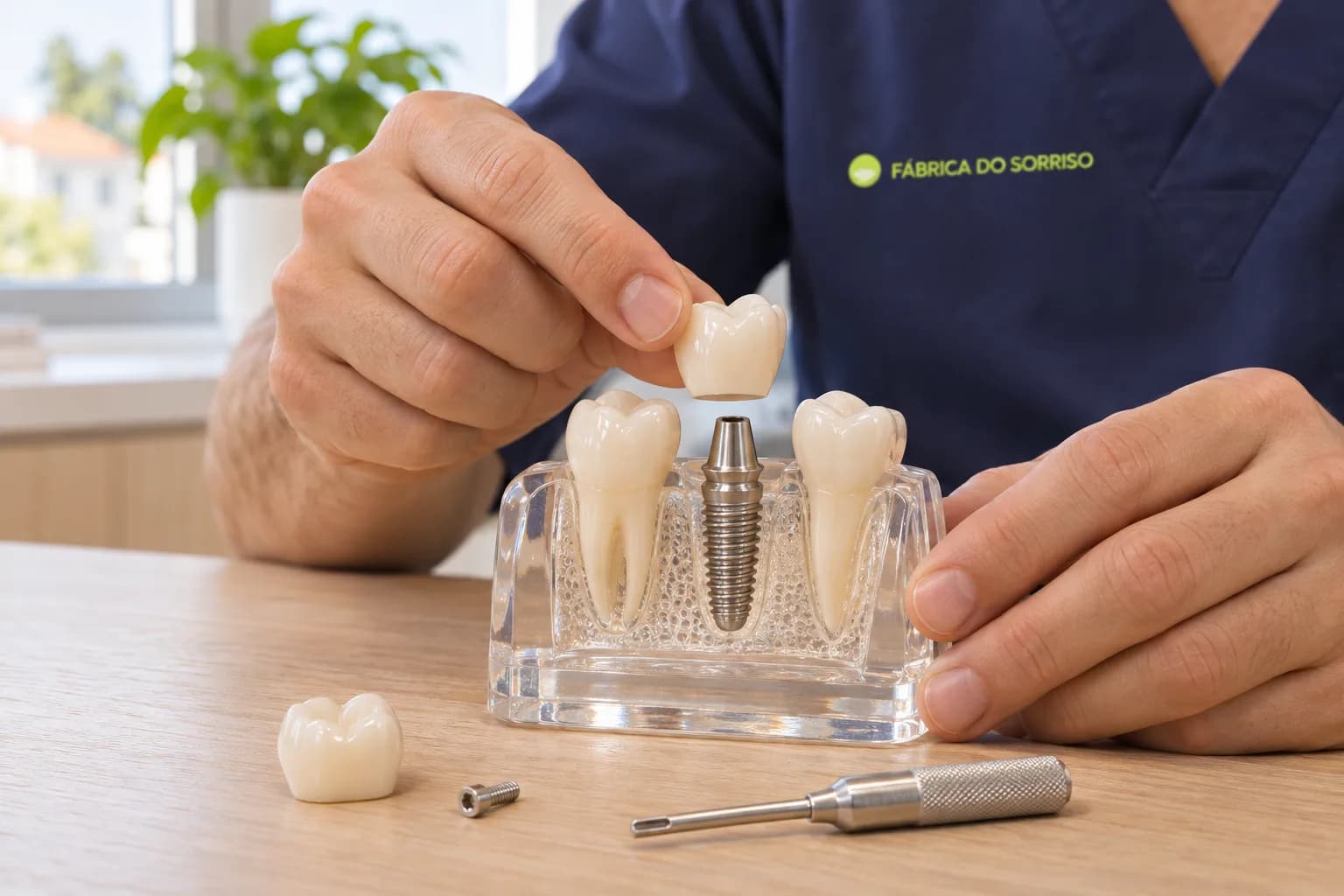
What are screwless dental implants?
In most cases, they are conventional implants in which the crown, the artificial tooth, is attached without a visible screw: it is cemented onto an abutment rather than screwed in place. The implant, the part that replaces the root, is still placed inside the bone and is almost always shaped like a screw.
The expression is not a technical term and is used with different meanings: cemented crowns, friction-fit systems, one-piece implants and, sometimes, fixed bridges that do not use implants at all. Before comparing proposals, always ask exactly what "screwless" refers to.
What ways are there of attaching the tooth to the implant?
There are four solutions that are commonly called, more or less accurately, "with" or "without a screw". The dentist makes the choice according to the position of the implant, the space available and the gum.
Screw-retained crown
the crown is held on the implant by a small screw. The access hole is on the chewing surface or on the back of the tooth and is filled with tooth-coloured resin.
Cement-retained crown
the crown is bonded with dental cement to an abutment fixed to the implant, like a crown on a natural tooth. There is no visible hole.
Friction fit
the crown or the abutment is held in place by a very tight conical fit, without cement. These systems are less common.
One-piece implant
the implant and the abutment are a single piece, with no screw between the two, and the crown is cemented on top. This is the design of many zirconia implants.
What are the advantages and limits of each fixing method?
A cemented crown has no visible hole; a screw-retained crown can be unscrewed and removed by the dentist without damaging it. This is the main trade-off, and neither is superior in every case. With a cemented crown, the abutment is still, as a rule, screwed to the implant: what disappears is the hole in the crown.
Reviews of clinical studies comparing the two fixing methods find no significant differences in crown survival; what changes is the type of complications. The European Federation of Periodontology includes cement remnants under the gum among the factors associated with inflammation around implants, although the evidence is limited.
- Cemented: no visible hole, which can benefit the appearance of the front teeth.
- Cemented: if excess cement is left under the gum, it can cause inflammation. This is why it requires careful technique and checking.
- Cemented: removing the crown for a repair is harder and may mean replacing it.
- Screw-retained: it can be removed for cleaning, repair or tightening, which makes maintenance easier over the years.
- Screw-retained: the screw can work loose over time. This is usually resolved at an appointment.
- Screw-retained: the implant must be in a position that allows the access hole to be hidden.
Who is a crown with no visible screw suitable for?
It is an option mainly when the position or angle of the implant would make the screw hole come out in a visible part of the tooth, which happens more often in the front teeth. In those cases, a cemented crown, or an abutment that corrects the angle, avoids a visible hole.
When the implant is well positioned for the screw, many dentists prefer a screw-retained crown because it is easier to maintain. In rehabilitations of several teeth or of a full arch, the fixed prosthesis is, as a rule, screw-retained, precisely so that it can be removed and cleaned at an appointment. The decision is made after the examinations and should be explained to you before you start.
Are there screwless implants for older people?
There is no implant specifically for older people. Age by itself is not a contraindication and does not call for a different implant: what counts is general health, medication and the bone available, assessed at the consultation.
What adverts describe as a "screwless solution for older people" is normally one of two things: a crown or bridge cemented onto implants, or a removable denture that fits onto implants and no longer moves when you speak and chew. In both cases there are implants placed in the bone, with surgery.
Is it possible to have a fixed prosthesis without an implant?
Yes. A fixed bridge replaces one or more missing teeth by resting on the neighbouring teeth, without surgery and without implants. To support it, those teeth have to be prepared, that is, filed down to take crowns.
It is a solution to consider when the neighbouring teeth already need crowns or when implants are not suitable. It has limits: it depends on the health of the supporting teeth and does not replace the root, so the bone in that area continues to shrink over time. The oral rehabilitation team explains what each option involves in your case.
Is a screwless implant cheaper, or does it avoid surgery?
No. The surgery to place the implant is the same whether the crown is cemented or screw-retained, and so is the recovery. The price depends mainly on the number of implants, whether a bone graft is needed, the type of crown and the examinations, not on the fixing method.
Be wary of promises of implants "without surgery", "without pain" or the same for every case. A serious quote identifies the implant system, the type of crown and of fixing, and what is included.
How do we choose the fixing method at Fábrica do Sorriso?
At Fábrica do Sorriso, the choice between a screw-retained and a cemented crown is made case by case, after the clinical examination and imaging, including a 3D CT (CBCT) scan when the position of the implant needs to be planned. The team explains which fixing method it proposes and why, and you receive the plan and the quote in writing before you decide.
We work with Straumann and MegaGen implants and, for those who prefer a solution without metal, we assess one-piece zirconia implants. We place implants in Almada, Fernão Ferro and Baixa da Banheira.
The most common questions
- Are screwless implants better than traditional ones?
- They are neither better nor worse: they are different ways of attaching the crown to the implant. A cemented crown has no visible hole; a screw-retained crown is easier to remove for maintenance. Reviews of studies find no significant differences in crown survival.
- Can you see the screw in a screw-retained crown?
- No. The screw sits inside the crown, and the access hole is filled with tooth-coloured resin. In the back teeth it is on the chewing surface; in the front teeth, the implant is planned so that it is on the back of the tooth.
- Can a cemented crown come loose?
- It can happen, just as with a crown on a natural tooth. If you feel the crown moving, do not force it or try to glue it back: contact the clinic to have it assessed.
- Does getting a screwless implant hurt less?
- There is no difference. The surgery is carried out under local anaesthetic and is the same in both cases; attaching the crown, months later, does not hurt. The discomfort in the first few days depends on the surgery, not on the type of crown.
- What is a screw-retained fixed prosthesis on implants?
- It is a prosthesis of several teeth, or of a full arch, held by screws on implants placed in the bone. The patient does not take it out: only the dentist unscrews it, for maintenance. All-on-4 is one example, with a fixed arch supported by four implants.
- How long does an implant with a cemented or screw-retained crown last?
- There is no guaranteed lifespan. How long it lasts depends mainly on daily hygiene, maintenance appointments, not smoking and keeping conditions such as periodontitis and diabetes under control, more than on the fixing method.

Author: Fábrica do Sorriso Team
Last updated November 15, 2026. This article is for information only and does not replace an appointment.