
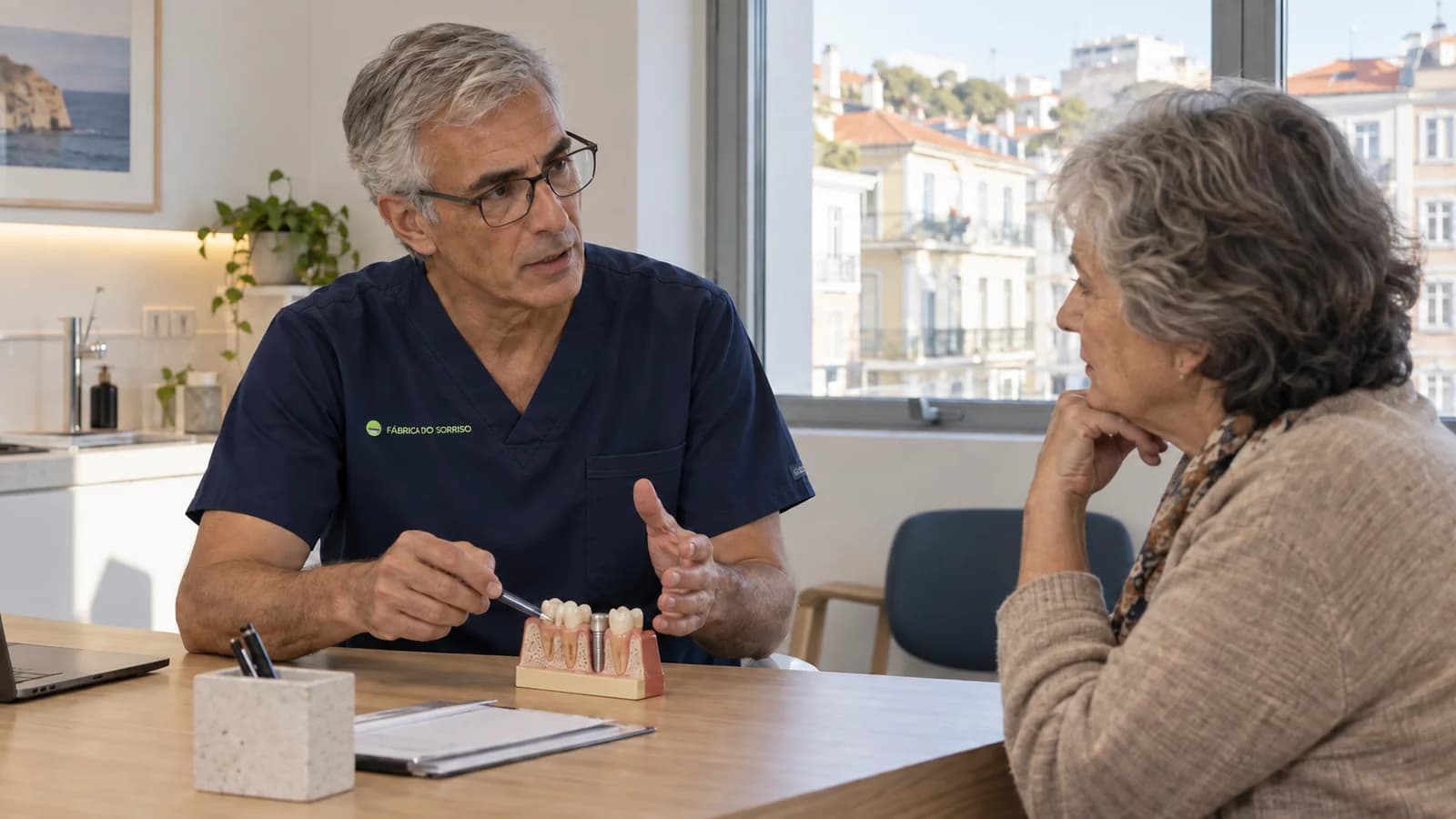
What is a dental implant?
A dental implant is a small screw-shaped structure that replaces the root of a lost tooth. It is placed in the jawbone and, once integrated, receives a crown — the visible part that reproduces the shape and colour of a natural tooth.
Unlike removable dentures, an implant is fixed in place, does not rely on the neighbouring teeth (as traditional bridges do), and stimulates the bone it sits in, helping to slow the bone loss that naturally occurs when a tooth is lost.
Who are implants suitable for?
Implants are suitable for most adults who have lost one or more teeth and have their oral health under control. Age by itself is not a barrier — what matters is the quantity and quality of available bone and the condition of the gums.
The assessment compares implants with options such as bridges or removable dentures. The choice depends on oral health, bone, maintenance needs and your priorities. Implants may be an option for:
- Replacing a single tooth without grinding down the neighbouring teeth.
- Replacing several teeth with fixed implant-supported bridges.
- Stabilising or replacing removable dentures that hurt or come loose.
- Restoring a full arch with fixed implant-supported prostheses.
How does the treatment unfold, stage by stage?
Implant treatment follows a well-defined pathway:
1. Assessment and planning
a clinical and radiographic examination to evaluate the bone, the gums and your general health. This is where the plan and the quote are defined.
2. Implant placement
a procedure carried out under local anaesthetic, generally simpler and more comfortable than patients expect.
3. Osseointegration
the healing period during which the bone bonds to the implant. It usually takes a few months, varying from case to case.
4. Crown fitting
once integration is complete, the final crown is fitted, designed to match your smile.
5. Maintenance
regular check-ups and professional cleanings, which are decisive for the implant's longevity.
How much do dental implants cost?
It's the most common question — and the honest answer is: it depends. The price varies with the number of implants, the material chosen, the type of crown or prosthesis, and whether additional procedures, such as bone grafting, are needed.
That's why any serious quote starts with an assessment appointment, where the treatment plan is defined in detail and with no surprises.
To make treatment more affordable, Fábrica do Sorriso offers financing in instalments through Cofidis Pay and has agreements with several insurers and health subsystems — ask us at your appointment or see our financing and insurance pages.
Titanium or zirconia implants: what's the difference?
Titanium is the classic implant material: light, strong, and backed by decades of clinical use proving its reliability and biocompatibility.
Zirconia is a ceramic, metal-free alternative, white in colour. It is sought out by patients who prefer metal-free solutions, whether due to known sensitivities or for aesthetic reasons — particularly in areas where the gum is thin and a metal implant might show through.
At Fábrica do Sorriso we work with both options. The choice is made case by case, based on the clinical situation, the patient's preferences and the area of the mouth being restored.
What aftercare does an implant need?
In the first few days after placement, the recommendations are simple: soft foods, no intense physical exertion, no smoking, and taking the medication prescribed by the clinical team.
In the long term, an implant is cared for like a natural tooth — careful brushing, floss or interdental brushes, and regular professional cleanings. The main threat to an implant's longevity is inflammation of the surrounding tissues (peri-implantitis), which is prevented precisely through good hygiene and regular check-ups.
Where can you get dental implants on the Margem Sul?
Fábrica do Sorriso provides implant treatment at its three clinics on the south bank of the Tagus (Margem Sul) — Almada, Fernão Ferro and Baixa da Banheira — also welcoming patients from Seixal, Corroios, Cacilhas, Cova da Piedade, Feijó, Sesimbra, Quinta do Conde, Moita, Barreiro and Alhos Vedros.
The first step is always the same: an assessment appointment to study your case and present a clear treatment plan, with all the options and prices.
The most common questions
- Does getting a dental implant hurt?
- Placement is done under local anaesthetic and most patients describe the procedure as more comfortable than they expected. After the procedure there may be some discomfort and mild swelling for a few days, manageable with the medication prescribed by the clinical team.
- How long does a dental implant last?
- With good oral hygiene and regular maintenance appointments, an implant can last many years — often decades. Longevity depends above all on daily care, professional follow-up and factors such as smoking, which increases the risk of complications.
- Is there an age limit for dental implants?
- There is no upper age limit based on age alone. General health, medication, bone, gums and the ability to maintain care all need assessment. In young people, bone growth must be complete. Suitability is always individual.
- What happens if I don't replace a missing tooth?
- Over time, the neighbouring teeth tend to tilt into the empty space and the opposing tooth can over-erupt. The bone in the area gradually shrinks for lack of stimulation, chewing becomes unbalanced, and any future replacement becomes more complex. The sooner you treat it, the simpler the solution.
- Can I pay for implant treatment in instalments?
- Yes. Fábrica do Sorriso offers financing through Cofidis Pay, which lets you pay for treatment in instalments. We also have agreements with various insurers and health subsystems that may cover part of the treatment.

Author: Dr. Carlos Sousa
Last updated October 7, 2026. This article is for information only and does not replace an appointment.