
How does each type of brace work?
Fixed braces use brackets bonded to the teeth and a metal archwire that is adjusted periodically by the orthodontist. The force applied is continuous and controlled to the millimetre, tooth by tooth.
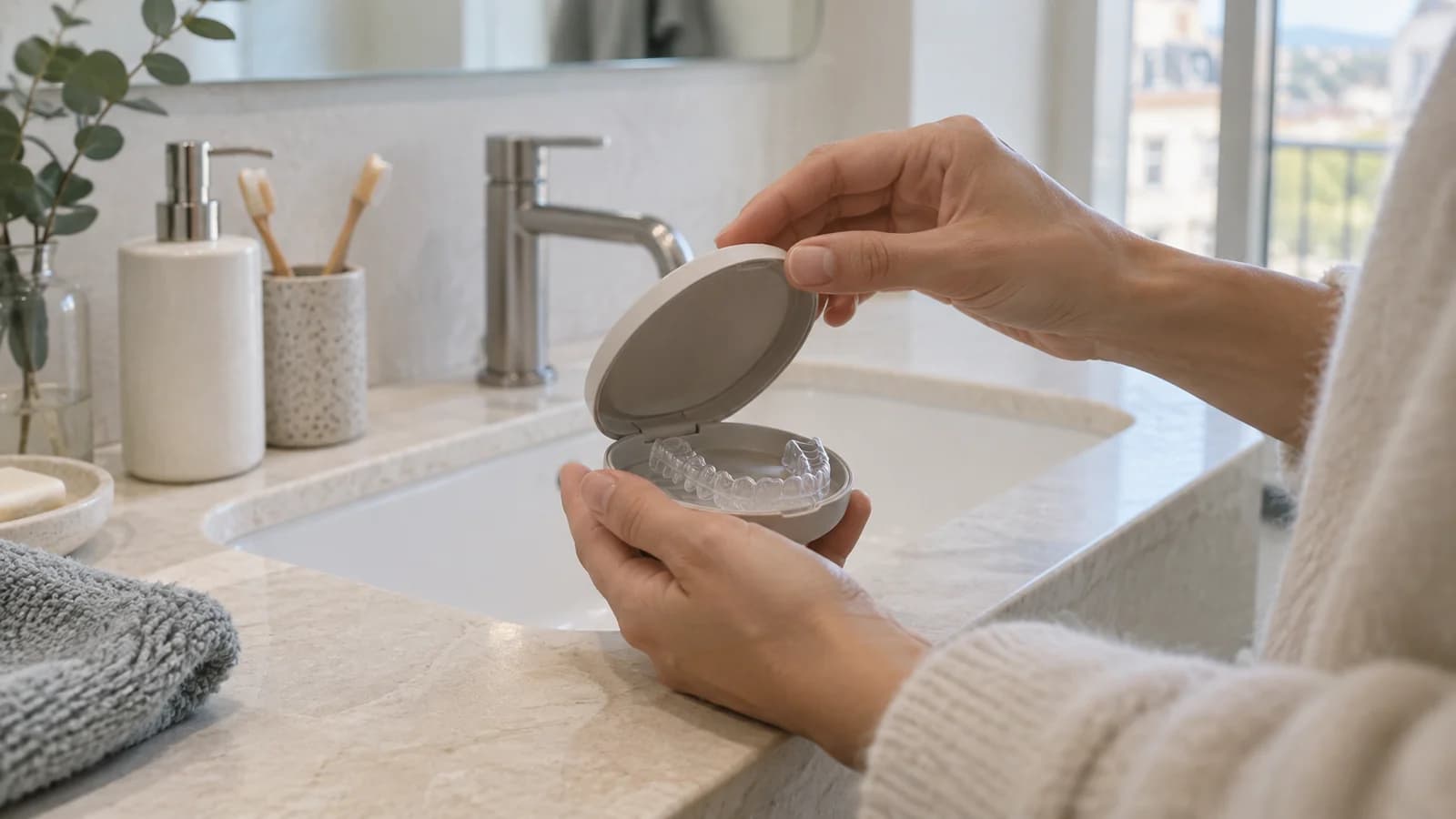
Invisible aligners work as a series of custom-made clear trays. Each aligner is worn for around one to two weeks and moves the teeth gradually towards the position digitally planned at the start of treatment. At Fábrica do Sorriso we work with invisible aligners, including the Invisalign system.
What are the main differences in everyday life?
In practice, the differences patients notice most are these:
- Appearance — aligners are virtually invisible; metal brackets are visible (there are less noticeable ceramic options).
- Hygiene — aligners come out so you can brush and floss as normal; with fixed braces, hygiene takes more time and technique.
- Eating — with aligners you can eat anything, because you take them out at mealtimes; with fixed braces there are foods to avoid (hard, sticky).
- Comfort — aligners have no metal parts that can rub against your cheek; with both options there is pressure and sensitivity in the first few days after each adjustment.
- Commitment: aligners require 20 to 22 hours of daily wear. Fixed braces stay in place, but also depend on home care and following instructions.
- Appointments — both require regular follow-up, but aligner appointments tend to be quicker.
Which of the two is faster and more effective?
It depends on the case — and be wary of anyone who promises otherwise without assessing it. For mild to moderate corrections, aligners achieve results in timeframes comparable to fixed braces, as long as they are worn for the recommended hours.
In complex cases — large tooth rotations, significant bite problems, difficult vertical movements — fixed braces often remain the more predictable option, although aligner technology has greatly expanded the range of treatable cases.
The total length of orthodontic treatment typically ranges from a few months to two or three years, depending on complexity. Only an assessment with the orthodontist can give a concrete timeframe for your case.
When is it worth choosing invisible aligners?
Invisible aligners tend to be the preferred choice of adults and teenagers who value discretion — at work, socially or at school — and the freedom to eat without restrictions.
They are also an excellent option for anyone who wore braces in the past and has had a relapse (the teeth have shifted again), because these cases are often moderate corrections, ideal for aligners.
When are fixed braces the better choice?
Fixed braces are often recommended when the case requires complex tooth movements, or when the orthodontist anticipates that the wear-time discipline aligners demand won't be kept — for example, in younger patients.
Because they are always in place, they remove the risk of treatment falling behind due to forgetfulness. For anyone who doesn't mind the braces being visible, they remain an effective, reliable and extensively proven solution.
How do you start orthodontic treatment in Almada, Fernão Ferro or Baixa da Banheira?
The starting point is an orthodontic assessment at one of the three Fábrica do Sorriso clinics on the south bank of the Tagus (Margem Sul). At that appointment the diagnosis is made, the options are discussed — invisible aligners, Invisalign or fixed braces — and you receive a plan with timeframes and prices.
We welcome patients from Almada, Cacilhas, Pragal, Cova da Piedade, Feijó, Seixal, Corroios, Fernão Ferro, Sesimbra, Quinta do Conde, Baixa da Banheira, Moita, Barreiro and nearby areas.
The most common questions
- Do invisible aligners hurt?
- It's normal to feel pressure and some sensitivity in the first few days with each new aligner — it's a sign the teeth are moving. This discomfort is usually mild and short-lived, and most patients find it less than with fixed braces, as there are no metal parts to rub.
- Can I eat with my aligners in?
- No — aligners should be taken out to eat and to drink anything other than water. That is, in fact, one of their advantages: you eat whatever you like and brush your teeth as normal before putting them back in.
- How long does treatment with aligners take?
- It depends on the complexity of the case: mild corrections can be completed in a few months, while moderate to complex cases can take one to two years or more. The digital plan created at the start of treatment makes it possible to estimate the duration quite accurately.
- Is the result of orthodontic treatment permanent?
- Teeth have a natural tendency to shift throughout life. That's why, after any orthodontic treatment — fixed or invisible — it is essential to wear a retainer (a fixed or removable maintenance device) as directed by the orthodontist, to preserve the result.
- Do the Fábrica do Sorriso clinics offer Invisalign?
- Yes. At the Almada, Fernão Ferro and Baixa da Banheira clinics we offer treatment with invisible aligners, including the Invisalign system, as well as orthodontics with fixed braces. The most suitable option is decided at the assessment appointment.

Author: Dr. Carlos Sousa
Last updated October 7, 2026. This article is for information only and does not replace an appointment.