
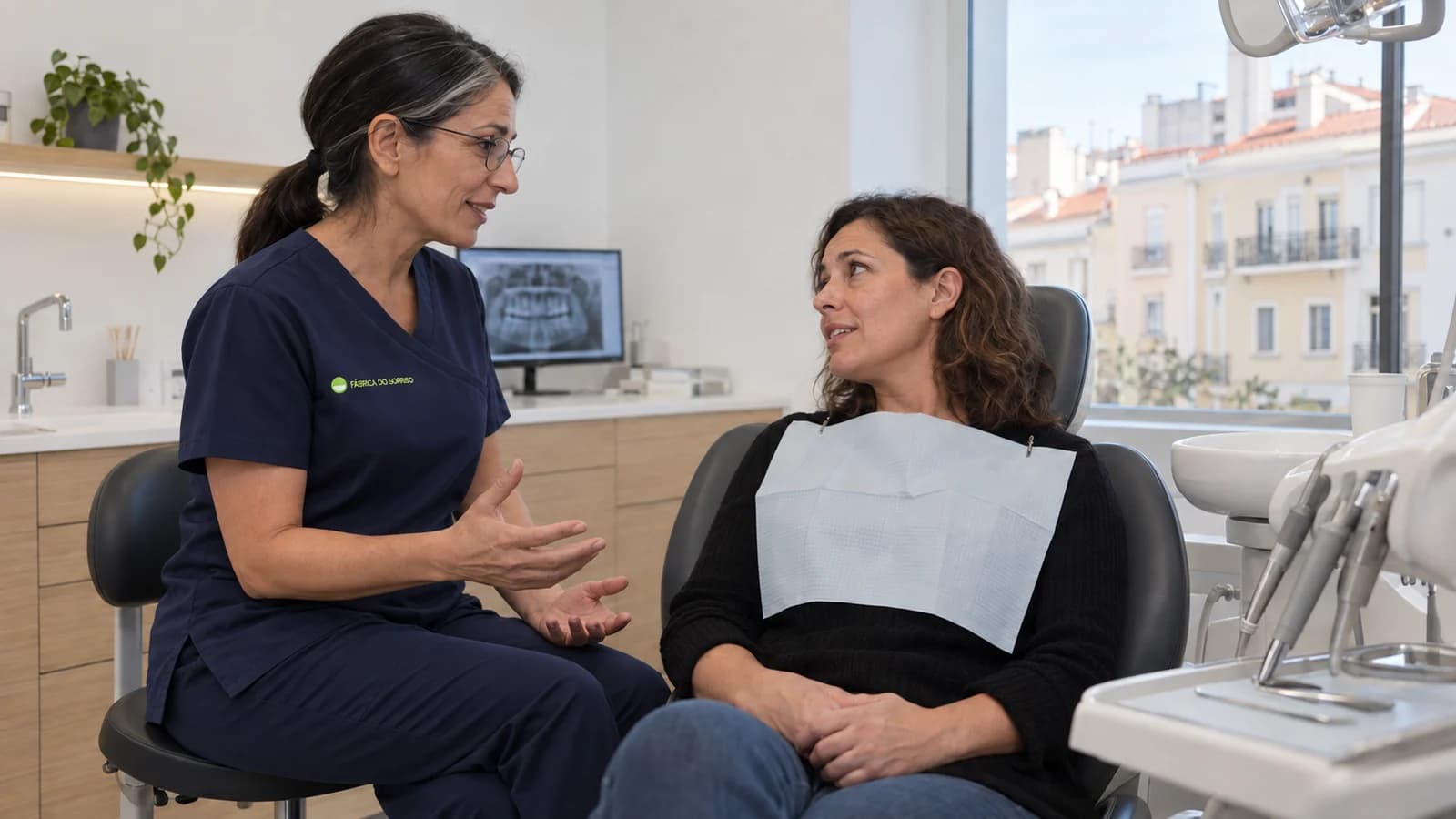
Why are we afraid of the dentist?
Dental anxiety rarely appears out of nowhere. It almost always has one of four origins: a negative experience in the past (often in childhood, at a time when dentistry really was more aggressive), fear of pain, the feeling of losing control — lying down, mouth open, unable to speak — or embarrassment about the state of your teeth after years without appointments.
That last one deserves special mention, because it is the one that delays appointments the most: people who feel embarrassed avoid going, and the longer they put it off, the worse it gets — and the greater the embarrassment. We know this cycle well and we say it plainly: our job is to treat, not to judge. No state of the mouth surprises us, and the decision to book an appointment always deserves respect — never a lecture.
Which strategies really work against dental anxiety?
There is a set of strategies with proven effectiveness in clinical practice — and almost all of them depend on one simple thing: telling us you are afraid. From there, we adapt everything:
- Start with an appointment with no treatment — come and get to know the place, the team and talk about what worries you. No drill, no surprises.
- Agree on a "stop" signal — raise your hand and everything stops. Regaining control dismantles much of the fear.
- Ask to have things explained before they are done — knowing what is going to happen (and what you will feel) reduces the anxiety of uncertainty.
- Move forward in stages — first an assessment, then a gentle cleaning, and only then bigger treatments. Each positive experience rewrites the memory of the previous one.
- Bring headphones and music — or use the pauses to breathe deeply: breathe in for 4 counts, out for 6.
- Book a morning appointment — it stops you spending the whole day anticipating the visit.
- Don't go in pain, go before the pain — preventive appointments are short and comfortable; emergencies are the worst-case scenario for anyone who is afraid.
What can the clinic do differently?
On our side, the approach to an anxious patient changes the appointment from start to finish: more time booked, a pace set by you, step-by-step explanations and pauses whenever you need them.
Before starting, tell us what worries you most, including past experiences with anaesthesia or cleaning. We use GBT with AIRFLOW®, warm water and fine powder; residual tartar may need ultrasound. Sensations vary, so we agree on pauses and adjust care throughout the session.
With children, we start by building trust: age-appropriate language, time to explore the space and gradual familiarisation. If your child is in pain, call before coming so we can assess urgency and confirm the earliest availability.
When does fear need more than goodwill?
When the anxiety is so intense that it has prevented appointments for years — with a racing heart, sleeplessness the night before, panic attacks or total avoidance — we are talking about dental phobia. Here, willpower is rarely enough, and there is nothing wrong with that: it is a health problem like any other, and it can be treated.
Psychological support is effective for specific phobias, through approaches such as gradual exposure and work on the associated catastrophic thoughts. At the Fábrica do Sorriso polyclinic in Fernão Ferro there are psychology appointments for children, adolescents and adults — in a confidential, judgement-free space — which can be coordinated with the dental team to prepare and support your return to the dentist, step by step.
What if I haven't been to the dentist in many years?
Then this article is for you — and the message is simple: it is never too late, and the first step is smaller than you imagine. An assessment appointment commits you to nothing: we examine, we talk, and you leave with a realistic, phased and costed plan, in the order that makes sense for you — clinically and financially.
What we almost always find in these cases: problems that are simpler to solve than the patient feared, and enormous relief at finally having taken the step. We see patients in Almada, Fernão Ferro and Baixa da Banheira, and you can tell us right when booking that it is a "return" appointment — we will prepare everything so it goes calmly.
The most common questions
- Is it normal to be afraid of the dentist?
- Completely. Dental anxiety is among the most common anxieties in both adults and children, and in most cases it stems from old negative experiences. It is not a sign of weakness or a reason for shame — and there are effective strategies to overcome it, at your own pace.
- I'm embarrassed about the state of my teeth. Will you judge me?
- No. Our job is to treat, not to judge — and no state of the mouth surprises us. The decision to book an appointment after years of staying away deserves respect, and that is how we receive it: with a calm, phased plan, never with a lecture.
- What is dental phobia and how is it treated?
- It is the most intense degree of dental anxiety: a fear that prevents appointments for years, with physical symptoms such as a racing heart or panic. It is treated with a combination of an adapted clinical approach (small steps, patient control) and psychological support — available at our Fernão Ferro polyclinic, in coordination with the dental team.
- Do today's appointments hurt like they used to?
- Comfort measures and anaesthesia are adapted to the treatment and your sensitivity. You may feel pressure or discomfort, and it is important to tell us what you feel. We agree on a pause signal and explain each step before proceeding.
- How do I help my child not be afraid of the dentist?
- Talk about the dentist positively, avoid words like "pain" or "needle", and start appointments early — before there is any problem. In paediatric dentistry, the first visits are about habituation: the child gets to know the place and the team at their own pace. And be careful not to pass on your own fear: if you suffer from dental anxiety, let another adult accompany the appointment.

Author: Dr. Carlos Sousa
Last updated October 7, 2026. This article is for information only and does not replace an appointment.