
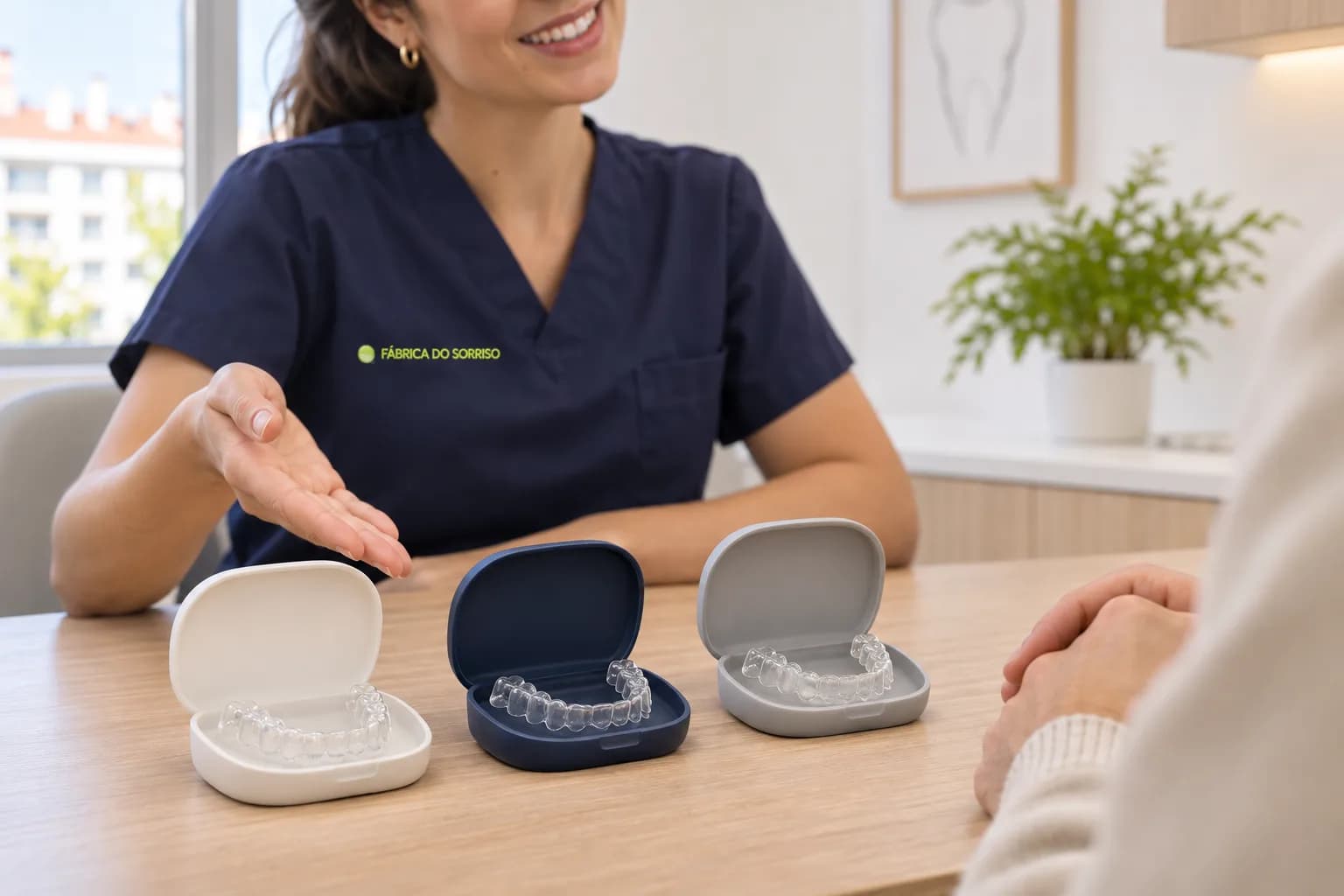
What do Invisalign, Spark and Angel Aligner have in common?
All three are clear aligner systems: a series of thin, custom-made trays that are changed in stages to move the teeth gradually. They are removable and barely noticeable, and they replace the brackets and wires of fixed braces in the cases where they are suitable.
The pathway is the same for all three brands. It starts with a clinical examination and an intraoral scan, moves on to a digital plan showing the planned movements, and continues with review appointments. At Fábrica do Sorriso, the usual guidance is to wear the aligners for 20 to 22 hours a day, with reviews generally every 6 to 8 weeks and a reference duration of 6 to 18 months, depending on complexity.
What are the differences between the three brands?
The differences lie in who makes them, the material of the trays and the software the orthodontist uses to plan the treatment. None of these features guarantees a better result by itself.
Invisalign
made by Align Technology, an American company founded in 1997. It uses the SmartTrack material and the ClinCheck planning software. It is the oldest of the three brands and the best known.
Spark
made by Ormco, an American orthodontics company. It uses the TruGEN material and, for finishing stages, the stiffer TruGEN XR. The plan is prepared in the Approver software.
Angel Aligner
made by Angelalign Technology, a company founded in Shanghai in 2003. The treatment plan is prepared on the iOrtho platform.
Do the material and the software change the result?
Less than the advertising suggests. Each manufacturer claims advantages for its own material: Ormco, for example, states that TruGEN is clearer and resists staining better than the leading brand. This is the manufacturer's own data, and there are still few independent studies that compare the three brands directly.
The result depends mainly on three things: a thorough diagnosis, a plan that is well designed and reviewed by the orthodontist, and keeping to the hours of wear. A well-known brand of aligner does not make up for a poorly designed plan or for hours of wear that are missed.
Which aligner is best for my case?
The best aligner is the one the orthodontist can plan and monitor well for the movements your teeth need. Mild crowding, gaps between teeth and bite problems call for different plans, and there are cases where fixed braces remain the most suitable option.
At your appointment, our team compares the systems available for your case and explains why it recommends one of them. These are the questions worth asking before you decide:
- Which tooth movements are needed, and which are the hardest to achieve with aligners?
- How many aligners and how many months does the initial plan provide for?
- Will I need attachments (small bumps bonded to the teeth) or elastics?
- What happens if additional aligners, known as refinements, are needed at the end?
- What retention is planned to maintain the result, and for how long?
Is there a price difference between Invisalign, Spark and Angel Aligner?
There can be, but the price depends more on the complexity of the case than on the brand. The number of aligners, the duration, refinements and retention weigh more on the final amount than the name of the system.
Fábrica do Sorriso does not publish one fixed price for aligners. After the assessment, you receive in writing the recommended option, the alternatives and the total cost of each, including follow-up and retention. The price of the first consultation is published on our prices page, and you can discuss paying in instalments through Cofidis Pay, subject to Cofidis approval.
Can I buy aligners online, without seeing a dentist?
It is not recommended. Moving teeth is a medical treatment that requires an in-person diagnosis, X-rays when indicated and regular monitoring, because a poorly planned movement can affect the gums, the roots and the bite.
In 2022 the Portuguese Dental Association (Ordem dos Médicos Dentistas) launched a campaign warning of the risks of buying dental braces on the internet and of having orthodontic treatment without any contact with a dentist, and in 2024 it called for aligners sold online to be regulated. The three brands in this article are prescribed by dentists and monitored in the clinic.
Where can you get Invisalign, Spark or Angel Aligner on the Margem Sul?
Fábrica do Sorriso offers all three systems at its clinics in Almada, Fernão Ferro and Baixa da Banheira. The orthodontic assessment includes an examination of your oral health and bite, and the intraoral scan makes it possible to create the digital model and the simulation of the planned movements.
We welcome patients from across the Margem Sul, including Seixal, Corroios, Quinta do Conde, Moita and Barreiro. When booking, say that you would like an aligner assessment and, if you have had orthodontic treatment before, bring the details of that treatment.
The most common questions
- Which is better: Invisalign or Spark?
- Neither is better in every case. Invisalign is the oldest and best-known brand; Spark uses a material that its manufacturer describes as clearer and more resistant to staining. The orthodontist's plan and the hours of wear matter more to the result than the brand.
- Is Angel Aligner any good? Where is it from?
- Angel Aligner is made by Angelalign Technology, a company founded in Shanghai in 2003, and is planned on the iOrtho platform. It is an aligner system prescribed and monitored by dentists, just like Invisalign and Spark. Whether it is suitable depends on the assessment of your case.
- Does Spark stain less than Invisalign?
- Ormco, which makes Spark, states that the TruGEN material resists staining better than the leading brand. That is the manufacturer's own claim. In practice, any aligner stains less if you take it out to eat and to drink anything other than water, and if you clean it every day.
- Can I change aligner brand partway through treatment?
- It is possible in some situations, but it means a new scan and a new plan, and it may involve costs. Talk to your orthodontist before deciding: it often makes more sense to adjust the plan within the same system.
- How long does treatment take with each brand?
- The duration depends on the case, not on the brand. Fábrica do Sorriso's reference for aligners is 6 to 18 months, depending on complexity, with 20 to 22 hours of wear a day. The digital plan gives the estimate for your case before you start.

Author: Fábrica do Sorriso Team
Last updated November 15, 2026. This article is for information only and does not replace an appointment.